Related Posts

Kentucky law mandates that anyone selling tobacco, nicotine, or vapor products must hold a state-issued retail license as of July 1, 2026. If you’re a resident, vaper, or retailer in the Commonwealth, the rules are straightforward: no sales or purchases under age 21, and every retail location must be properly licensed. As vaping devices 2026 continue to evolve in design and capability, Kentucky’s regulatory framework has tightened to match federal baselines and address compliance gaps that left some retailers operating in gray areas.
The licensing requirement, which took effect this year, closed a long-standing loophole. Previously, many vape shops and convenience stores sold products without state oversight. Now, the Department of Alcoholic Beverage Control oversees approximately 5,500 licensed retailers, and businesses that missed the January 1, 2026 application deadline face enforcement action. The age restriction is unambiguous: selling, distributing, or even giving free samples to anyone under 21 is illegal, and underage purchase attempts carry their own penalties.
Understanding these laws matters whether you’re stocking a retail shelf, running an online storefront shipping into Kentucky, or simply trying to stay compliant as a consumer. This guide breaks down the current age limits, licensing obligations, and compliance steps required in 2026, offering the clarity needed to operate within Kentucky’s vaping legal landscape without guesswork.
Kentucky enforces a strict minimum age of 21 for all aspects of vaping. Under state law, no one under 21 may legally purchase, possess, or use vapor products. This means both the sale to minors and the purchase by minors are prohibited, retailers face penalties for selling to underage individuals, and those under 21 can be penalized for attempting to buy or possess these products.
The age 21 limits for vapor products in Kentucky align with the federal Tobacco 21 requirement which came into effect in December 2019. The federal law raised the national minimum age for purchasing tobacco and nicotine products to 21, creating a uniform baseline across all states. Kentucky’s state statute mirrors this standard, ensuring consistency for retailers operating in the state and clarity for consumers.
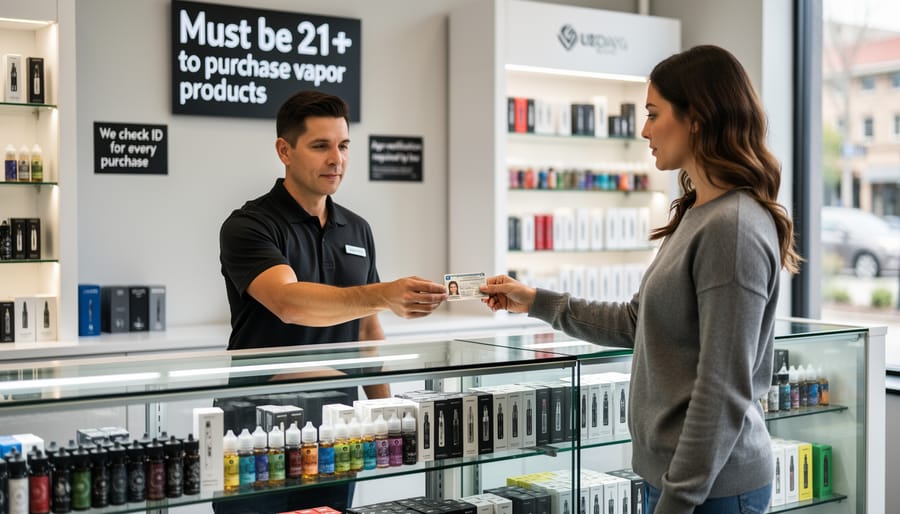
Enforcement responsibility falls primarily on retailers, who must verify the age of any customer appearing under 27 before completing a sale. This includes checking valid government-issued photo identification. Retailers who fail to comply risk fines and potential loss of their license to sell vapor products. For consumers under 21, attempting to purchase or possessing vapor products can result in legal consequences, though enforcement targeting minors varies.
The dual prohibition, on selling and on buying, reflects Kentucky’s intent to reduce youth access to nicotine and vapor products. It places accountability on both sides of the transaction. Retailers are expected to maintain diligent ID checks and refuse sales to anyone who cannot prove they’re at least 21, while minors are discouraged from seeking out these products through the threat of penalties. This framework, consistent with federal policy, sets clear expectations for legal vaping in Kentucky.
Any business that sells tobacco, nicotine, or vapor products at retail in Kentucky must obtain a state license. This requirement applies broadly across retail formats: dedicated vape shops, convenience stores, gas stations, pharmacies, tobacco shops, and any brick-and-mortar outlet offering these products to customers. The licensing mandate covers both large chains and independent retailers operating within the state.
Online retailers also fall under this requirement if they sell vapor products to Kentucky residents. Even if your business operates from outside Kentucky, you must hold a valid Kentucky retailer license to ship or deliver vapor products to addresses within the state. This ensures all sales channels meet the same compliance standards, regardless of where the transaction originates.
The law does not exempt small retailers or occasional sellers. If you sell vapor products at retail, even as a secondary product line, you need a license. Approximately 5,500 licenses have been issued by the Department of Alcoholic Beverage Control since the program launched, reflecting the wide scope of businesses affected.
Retailers who only sell products containing no tobacco, nicotine, or vapor components do not need a license. However, most vape devices and e-liquids fall within the regulated categories.
The state’s licensing framework rolled out in two critical phases. Kentucky’s January 1, 2026 application deadline marked the cutoff for retailers to submit their paperwork to the Department of Alcoholic Beverage Control. Six months later, on July 1, 2026, the compliance requirement took full effect, meaning any retailer selling tobacco, nicotine, or vapor products without a valid license now faces enforcement action.
If you’re a retailer who hasn’t yet applied, the January deadline has passed, but enforcement didn’t begin until July. That creates a potential gap. Contact the Department of Alcoholic Beverage Control directly to determine your status and whether late applications are accepted or if penalties apply. Don’t assume you can operate unlicensed: the approximately 5,500 licenses already issued show the state is actively processing applications, and unlicensed sales expose you to legal consequences.
For compliant retailers, verify your license is current and displayed as required. If you’re planning to open a new vape shop or add vapor products to an existing store, start the licensing process immediately. The state’s enforcement timeline leaves no grace period for new entrants.

Kentucky law establishes strict boundaries around who can sell and who can receive vapor products. Retailers face clear prohibitions: it’s illegal to sell or distribute any tobacco, nicotine, or vapor product to anyone under 21. This ban extends beyond over-the-counter sales. Giving free samples to minors banned under state law, meaning promotional distribution at events or in stores must exclude anyone who hasn’t reached the legal age.
Retailers must verify age before every sale. That means checking a valid government-issued ID for any customer who appears under 27, a standard practice across the industry. Cashiers and staff need training on what constitutes acceptable identification and how to refuse a sale when a customer can’t prove their age. The responsibility sits squarely with the business: ignorance of a customer’s age isn’t a defense, and failing to check ID exposes retailers to legal consequences.
The licensing framework that took effect in 2026 reinforces these obligations. Licensed retailers are expected to maintain compliance records, train employees on age verification procedures, and ensure their sales practices align with state law. This isn’t just about avoiding penalties. It’s about operating within a regulatory system designed to keep vapor products out of the hands of minors while allowing legal-age adults access to the products they choose.
For consumers, these restrictions mean every purchase requires proof of age, whether you’re buying at a vape shop, convenience store, or ordering online from a Kentucky-licensed retailer.
If you vape in Kentucky, understanding where and how you can legally purchase vapor products matters for staying compliant and avoiding hassle. You can buy vape products from licensed retailers only, vape shops, convenience stores, and gas stations that hold a valid license issued by the Department of Alcoholic Beverage Control. Online purchases remain an option, but the retailer must verify your age and comply with Kentucky’s licensing requirements if they ship to the state.
Expect to show a valid government-issued ID every time you buy, even if you look well over 21. Retailers are legally required to verify that you’re at least 21 before selling any vapor product, and most will ask for ID regardless of your appearance. This isn’t just store policy; it’s the law. Retailers who sell to anyone under 21 face legal consequences, so strict ID checks protect both you and the business.
Possessing vapor products is legal if you’re 21 or older. Kentucky law prohibits purchase and possession by minors, but adults face no legal restrictions on carrying or using vape devices in most settings. Public use depends on local ordinances and private property rules, many workplaces, restaurants, and public buildings ban vaping indoors, even though state law doesn’t impose a blanket public-use prohibition. Check local rules before vaping in unfamiliar spaces.
The licensing system offers consumer protection you might not immediately notice. Licensed retailers must meet regulatory standards, which means they’re accountable for product quality and legal compliance. If you encounter issues, say, a disposable vape troubleshooting situation, you’re more likely dealing with a legitimate business than an unlicensed seller operating outside the system. Always purchase from licensed retailers to ensure you’re getting products from a source that’s verified and regulated by the state.

Kentucky’s age-21 requirement, retailer licensing system, and ban on sales to minors place the state squarely within a global movement toward stricter vaping regulation. While jurisdictions differ widely in approach, from outright bans to age verification paired with product standards, Kentucky’s framework shares more in common with countries prioritizing access control and retailer accountability than those imposing blanket prohibitions.
The table below compares Kentucky’s regulations with selected international jurisdictions:
| Jurisdiction | Minimum Age | Retailer Licensing | Sales Restrictions |
|---|---|---|---|
| Kentucky (USA) | 21 | Required (2026) | No sales to minors; ID verification |
| United Kingdom | 18 | Voluntary registration | No sales to minors; product standards enforced |
| Canada | 18-19 (varies by province) | Provincial licensing | No sales to minors; flavor restrictions in some provinces |
| Australia | 18 (prescription required) | Pharmacy-only sales | Nicotine vaping by prescription only |
| Thailand | N/A (banned) | N/A | Import, sale, and possession prohibited |
Countries like Australia and Thailand impose far stricter controls, with Australia requiring a prescription for nicotine vaping products and Thailand banning vaping outright. By contrast, the UK and Canada, like Kentucky, allow regulated retail sales with age verification, though the UK sets its threshold at 18 rather than 21. Canada’s provincial model mirrors Kentucky’s state-level licensing, with some provinces adding flavor bans to curb youth appeal.
Common regulatory themes emerge across permissive and restrictive frameworks alike. Age limits are nearly universal, even in jurisdictions with outright bans. Product standards, covering labeling, ingredient disclosure, and nicotine concentration, feature prominently in the UK and Canada, though Kentucky’s current laws focus primarily on sales and licensing rather than product composition. Advertising restrictions are widespread, with many countries banning vape ads targeting minors or glamorizing use. Retailer accountability, enforced through licensing and penalties for illegal sales, is a cornerstone of Kentucky’s approach and aligns with international best practices outlined in vaping facts 2026.
Kentucky’s regulatory stance reflects a middle path: more restrictive than fully permissive markets, yet far less prohibitive than jurisdictions treating vaping as a public health emergency requiring elimination rather than management.
Understanding Kentucky’s vaping regulations means knowing what to know about your rights and responsibilities as either a consumer or retailer. Below are answers to the questions we hear most often.
Kentucky does not have a statewide ban on vaping in public spaces, but local ordinances in cities and counties may restrict where you can use vapor products. Check your municipality’s rules before vaping indoors or in public areas.
Selling vapor products to anyone under 21 is illegal in Kentucky. Retailers who violate this law face penalties, and the sale prohibition applies to all tobacco, nicotine, and vapor products.
Only retailers need a license. If you’re purchasing vapor products for personal use, no license is required, but you must be at least 21 years old to buy or possess them.
Yes, but the online retailer must comply with Kentucky’s age-21 requirement and verify your age before completing the sale. Licensed retailers are responsible for ensuring compliance, even in remote transactions.
Kentucky does not currently impose flavor bans on vapor products, so you can purchase flavored e-liquids and devices from licensed retailers. However, all sales, whether in-store or online, must adhere to the state’s age and licensing rules. Retailers who began operating before July 1, 2026 were required to apply for a license by January 1, 2026, and the Department of Alcoholic Beverage Control has issued approximately 5,500 licenses to date. For consumers, the practical takeaway is straightforward: expect to show ID when purchasing, and buy only from licensed sellers to ensure you’re supporting compliant businesses.
Kentucky’s vaping laws in 2026 center on three core pillars: a minimum age of 21 for purchasing and possessing vapor products, mandatory retailer licensing for all businesses selling tobacco, nicotine, or vapor products, and strict prohibitions on sales to minors. These regulations place significant compliance responsibilities on retailers, who must hold valid licenses and verify customer age at every point of sale. For consumers, awareness of these laws ensures legal purchases and helps support a regulated marketplace.
Kentucky’s approach aligns with broader domestic and international regulatory trends emphasizing age verification and retailer accountability. From federal Tobacco 21 requirements in the United States to similar frameworks in the UK and Canada, jurisdictions worldwide are tightening controls to prevent youth access while maintaining legal pathways for adult consumers. The licensing system introduced in Kentucky reflects this global movement toward structured oversight.
As vaping regulations continue to evolve at state, federal, and international levels, staying informed is essential. Retailers should monitor compliance deadlines and licensing renewals, while consumers benefit from understanding their rights and responsibilities. Kentucky’s regulatory framework aims to balance public health goals with market access, a balance that requires ongoing attention from all stakeholders.