Related Posts
The environmental impact of smoking and vaping extends far beyond secondhand smoke, encompassing toxic waste, plastic pollution, and chemical contamination that affects ecosystems worldwide. While health effects dominate public discourse, the environmental footprint of these products represents a significant and growing concern that receives far less attention.
Every year, an estimated 4.5 trillion cigarette butts are discarded globally, making them the most littered item on Earth. These butts contain cellulose acetate filters that can take over a decade to decompose, leaching heavy metals, nicotine, and carcinogenic compounds into soil and waterways throughout that period. Vaping products add another dimension to this problem. Single-use disposable vapes contain lithium batteries, electronic waste components, and plastic cartridges that create a complex recycling challenge. Recent estimates suggest millions of disposable vapes are thrown away weekly in the United States alone, with most ending up in landfills where their batteries pose fire risks and their e-liquid residue can contaminate groundwater.
The full environmental cost includes manufacturing emissions, resource extraction for battery production, and agricultural impacts from tobacco farming. Tobacco cultivation drives deforestation in developing countries, requires intensive pesticide use, and depletes soil nutrients at unsustainable rates. Vape production depends on mining operations for lithium and rare earth metals, processes associated with habitat destruction and water pollution.
Understanding these impacts matters for anyone concerned about environmental responsibility. This article examines the mechanisms through which smoking and vaping harm ecosystems, breaks down the environmental footprint by product type, and explores evidence-based approaches to reducing this burden.
Environmental impact in the smoking and vaping context refers to the harm these products cause to natural systems throughout their entire existence. This goes far beyond what happens when someone lights a cigarette or takes a puff from a vape. It encompasses everything from growing tobacco in fields or mining lithium for batteries, to manufacturing devices in factories, shipping products globally, using them for weeks or months, and finally discarding them as waste.
The lifecycle concept is central here. A cigarette’s environmental journey starts with tobacco cultivation, moves through processing and packaging, continues during combustion, and ends when the butt gets tossed on the ground or into a bin. A vape device follows a similar path: raw materials extraction, manufacturing, distribution, use, and disposal. Each stage consumes resources and generates pollution.
These products affect four main environmental domains. Air quality suffers from manufacturing emissions, combustion byproducts, and aerosol releases. Water systems receive chemical runoff from tobacco farms and leachate from discarded products. Soil accumulates toxins from buried waste and agricultural pesticides. Waste management systems struggle with billions of non-biodegradable items each year, from filters to lithium batteries that pose fire risks in collection trucks.
The environmental toll of smoking and vaping begins long before anyone takes their first puff. Tobacco cultivation alone ranks among the most resource-intensive agricultural practices globally. Farmers apply an estimated 60 million pounds of pesticides and herbicides to tobacco fields annually, with many of these chemicals banned for food crops due to toxicity. These substances leach into groundwater and runoff into rivers, contaminating drinking water supplies and aquatic ecosystems.
Deforestation compounds the problem. Tobacco farming drives the clearing of approximately 200,000 hectares of forest each year, primarily in developing nations where tobacco provides economic opportunity but environmental regulations lag. Beyond land clearing for fields, curing tobacco leaves requires enormous quantities of wood fuel. One study found that producing enough tobacco for 300 cigarettes requires an entire tree, contributing to soil erosion and habitat loss once forests disappear.
Water consumption presents another burden. Tobacco plants demand roughly 650 gallons of water per pound of harvested leaf, straining water resources in regions already facing scarcity. This rivals the water intensity of notoriously thirsty crops like almonds.
Vaping devices carry a different but equally significant manufacturing footprint. Lithium-ion batteries require cobalt and lithium extraction, processes that generate toxic waste and disrupt landscapes through open-pit mining. The plastics in device bodies and cartridges derive from petroleum, adding to fossil fuel dependence. Circuit boards contain rare earth elements like neodymium, sourced through mining operations that produce radioactive tailings and contaminated groundwater.
Manufacturing a single disposable vape generates roughly the same carbon emissions as producing 10 cigarettes, yet lasts far fewer uses. Rechargeable devices demand greater upfront resources but spread that impact across longer lifespans.
When you light a cigarette or activate a vaping device, environmental impacts begin immediately through the release of chemicals and particulates into the surrounding air. Cigarette combustion releases over 7,000 chemicals, including carbon monoxide, benzene, and formaldehyde, directly into both indoor and outdoor environments. These compounds don’t simply disappear after exhalation, they deposit on surfaces, react with other atmospheric pollutants, and contribute to localized air quality degradation.
Vaping releases fewer combustion byproducts but still introduces volatile organic compounds, ultrafine particles, and aerosolized chemicals into the air. Research shows that propylene glycol and vegetable glycerin, the base ingredients in e-liquids, break down into formaldehyde and acetaldehyde when heated. These emissions accumulate in poorly ventilated spaces, affecting indoor air quality measurements.
The carbon footprint extends beyond the emissions themselves. Cigarette combustion releases approximately 0.2 grams of carbon dioxide per cigarette. Vaping devices require electricity, whether from charging batteries or powering the heating element, which carries its own carbon cost depending on local energy sources. While a single use seems negligible, the aggregate impact of millions of daily users becomes environmentally significant.
Secondhand aerosol and smoke don’t just pose health risks to bystanders. They deposit nicotine, heavy metals like lead and cadmium, and microplastics from synthetic filters onto surrounding surfaces and into soil and water systems when particles settle or wash away, extending the environmental reach beyond the moment of use.
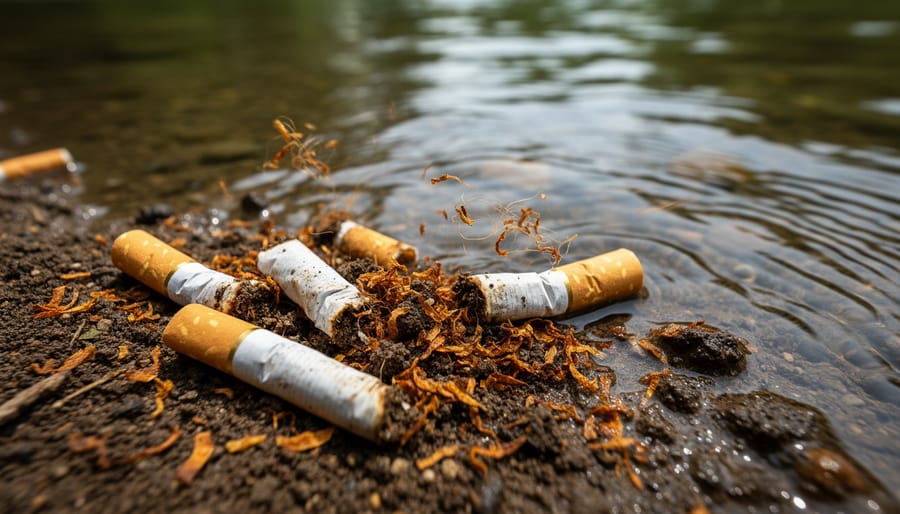
When smokers discard cigarette butts or vapers throw away devices, they’re adding to waste streams that environmental systems aren’t equipped to handle. The scale is staggering: an estimated 4.5 trillion cigarette filters are littered globally each year, making them the most commonly discarded item on the planet. This waste doesn’t disappear, it accumulates in streets, parks, beaches, and waterways, where it begins breaking down in ways that compound environmental damage.
Cigarette filters consist primarily of cellulose acetate, a form of plastic that can persist in the environment for a decade or longer. As these butts degrade, they fragment into microplastics while simultaneously leaching out the thousands of chemicals they’ve absorbed during smoking, including heavy metals like lead and cadmium, carcinogenic compounds, and residual nicotine. A single cigarette butt immersed in water can release enough toxins to kill half the fish exposed to that water in laboratory conditions. In real-world environments, these toxins seep into soil and groundwater, contaminating ecosystems and entering food chains.
Vaping products introduce different but equally concerning disposal challenges. Disposable vapes represent a particularly problematic category, each device combines plastic housing, a lithium-ion battery, residual e-liquid, and a heating coil in a single unit that’s typically not accepted by standard recycling programs. These devices are increasingly found in household trash, street litter, and marine debris. The batteries alone present multiple hazards: in landfills they can ignite, causing fires at waste facilities; when crushed or damaged, they may leak lithium and other heavy metals into surrounding soil and water.
Refillable vaping systems generate ongoing waste through e-liquid bottles (often non-recyclable colored plastic), replacement coils containing wire and wicking material, and cartridges. While the device itself may last months or years, these consumable components still require disposal. Packaging for all vaping products, boxes, plastic clamshells, instruction booklets, adds another waste layer that most users immediately discard. Unlike traditional consumer electronics with established e-waste channels, vaping devices exist in a grey area where proper disposal infrastructure is largely absent, meaning the vast majority end up in landfills or incinerators where their environmental impacts extend for decades.
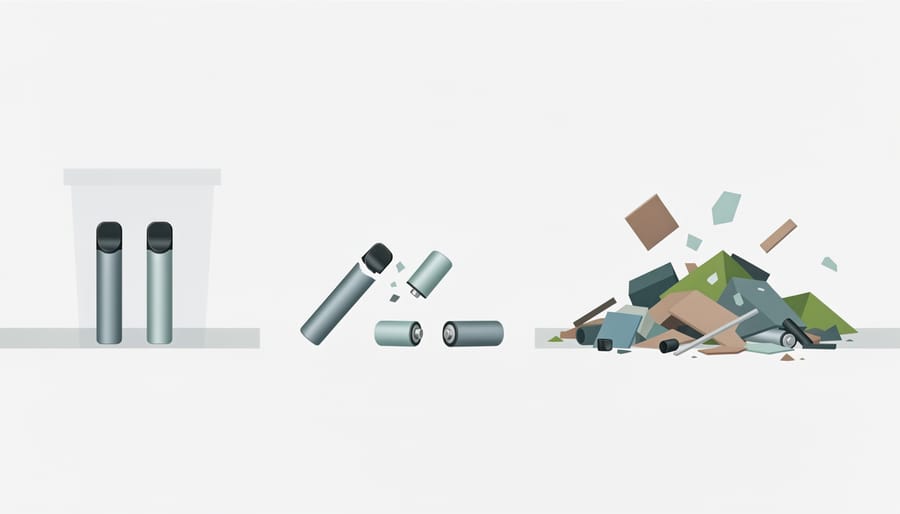
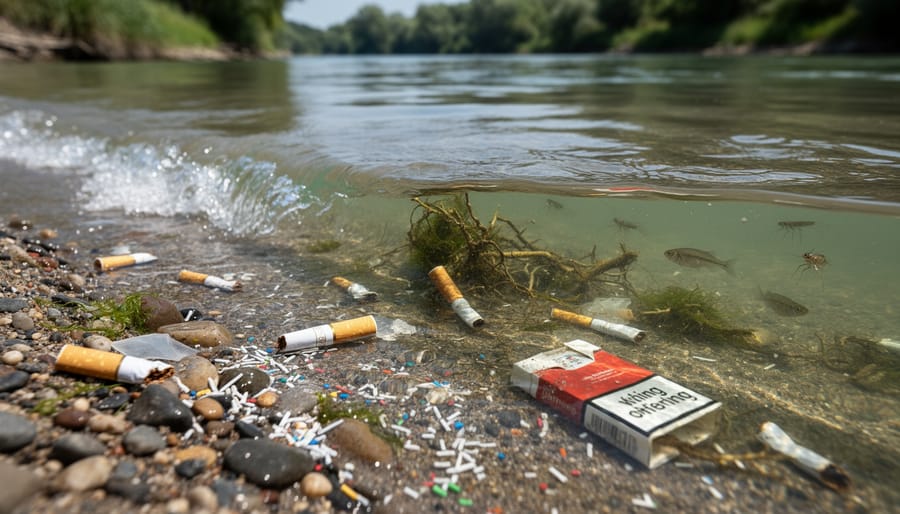
Research consistently shows that cigarette butts and vaping waste introduce nicotine, heavy metals like lead and cadmium, and microplastics into ecosystems where they harm a wide range of organisms. Aquatic life faces particular risk: studies document fish, crustaceans, and amphibians experiencing behavioral changes, reduced growth rates, and mortality after exposure to leachate from cigarette filters. A single cigarette butt in one liter of water can kill fish within 96 hours in laboratory conditions.
Birds and small mammals mistake discarded filters and vape components for food or nesting material, leading to ingestion of toxic residues. Soil organisms, including beneficial earthworms and microbes crucial for nutrient cycling, show reduced populations in areas with heavy cigarette litter. The nicotine alone acts as a potent pesticide in natural environments, while the plastics fragment into particles that bioaccumulate through food chains, affecting predators far from the original disposal site.
Traditional cigarettes create environmental damage at every stage of their lifecycle, beginning long before a smoker lights up. Tobacco farming depletes soil nutrients rapidly and relies heavily on pesticides and fertilizers that contaminate waterways. The crop demands substantial water, roughly 3.7 million liters per ton of tobacco produced, straining water supplies in growing regions. Deforestation for tobacco fields further compounds the ecological toll, particularly in countries like Brazil and Zimbabwe where forest clearing supports large-scale cultivation.
The environmental burden intensifies after use. Cigarette filters, made from cellulose acetate plastic, persist in ecosystems for over a decade, breaking down into microplastics that infiltrate soil and water. A single butt can contaminate 1,000 liters of water through chemical leaching, releasing arsenic, lead, nicotine and heavy metals as it degrades. With approximately 4.5 trillion cigarettes littered globally each year, these toxins accumulate in marine and terrestrial environments at staggering scales.
Combustion itself releases carbon dioxide, methane and volatile organic compounds into the atmosphere. Research indicates that cigarette smoke contributes particulate matter and air pollutants beyond the immediate health effects on smokers, affecting ambient air quality in densely populated areas.
Rechargeable vaping devices present a mixed environmental profile. Their primary advantage lies in longevity, a single mod can last years, distributing the manufacturing burden across thousands of uses rather than ending up in landfill after 600 puffs. But they’re not impact-free.
Lithium-ion batteries anchor the environmental concern. These require mining cobalt, nickel, and lithium, processes that scar landscapes and consume water. When the battery degrades after 300-500 charge cycles, proper recycling becomes critical. Yet most users bin dead devices rather than seeking specialist e-waste facilities, releasing heavy metals into soil.
E-liquid bottles add another layer. A moderate user goes through several 10ml or 30ml plastic bottles monthly. While technically recyclable, residual nicotine contamination means many councils reject them from standard streams. Glass bottles fare better but remain rare.
Coil replacements generate steady waste, mesh and wire assemblies swapped weekly or fortnightly depending on use. These small metal-and-cotton units can’t be recycled and contain trace heavy metals from the coil wire.
The trade-off remains clear: one rechargeable device replaces potentially hundreds of disposables, but only if users maintain it properly and dispose of components responsibly.
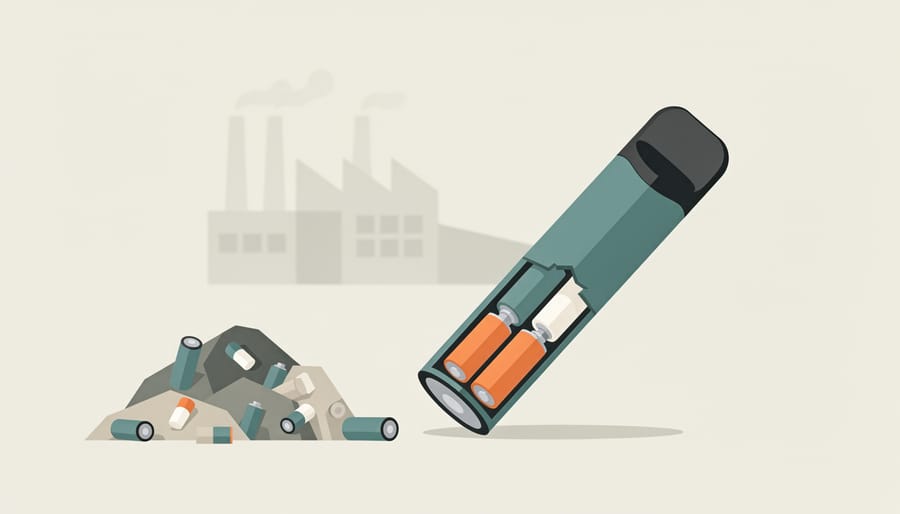
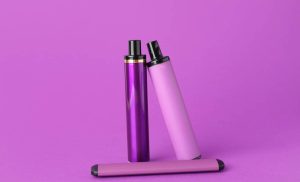
Disposable vapes have emerged as the most pressing environmental challenge in the vaping sector. These single-use devices pack multiple environmental hazards into one compact unit: a plastic outer shell, a lithium-ion battery, heating elements containing precious metals, and residual e-liquid containing nicotine and other chemicals. Unlike rechargeable systems where components can be separated, disposables are engineered as sealed units that cannot be easily disassembled for recycling.
Research from 2026 indicates that billions of disposable vapes enter waste streams annually, with disposal rates vastly outpacing recycling capacity. The UK’s Material Focus estimates that over 5 million disposable vapes are discarded weekly in Britain alone, contributing approximately 10 tonnes of lithium to landfills monthly, enough to manufacture batteries for 1,200 electric vehicles. These devices typically contain between 0.15 and 1 gram of lithium, yet fewer than 10 percent reach proper e-waste facilities.
The recycling barriers are substantial. Most municipal systems lack protocols for handling vapes, which combine hazardous battery components with plastic and liquid residues. The sealed construction makes manual disassembly dangerous due to fire and chemical exposure risks. Even disposable failures that stop working prematurely still contain significant battery charge, creating additional safety concerns in waste handling. Specialized recycling requires trained technicians and equipment most facilities don’t possess, leaving the vast majority to contaminate landfills or, when littered, directly pollute ecosystems with persistent plastics and toxic metals.
Studies examining the environmental footprint of smoking and vaping have accelerated in recent years, with 2026 marking a significant expansion in evidence-based assessment of these products’ ecological impacts. The research findings reveal complex environmental burdens that extend far beyond the immediate act of consumption.
Lifecycle analyses comparing traditional cigarettes to vaping devices show different environmental profiles rather than a clear winner. Cigarettes impose massive agricultural costs through tobacco cultivation, which requires intensive pesticide use and contributes to deforestation in several tobacco-growing regions. Manufacturing studies estimate the carbon footprint of producing and distributing cigarettes globally exceeds 84 million tons of CO2 annually. However, cigarette butts remain the dominant environmental villain: research continues to document their persistence in marine environments, with studies showing that a single discarded filter can leach toxic compounds into two liters of water, creating lethal concentrations for aquatic organisms.
Vaping research has shifted focus toward the waste crisis created by disposable devices. A 2025 study quantifying e-cigarette waste estimated that over 5 million single-use vapes are discarded weekly in the UK alone, each containing a lithium battery and approximately 0.15ml of residual e-liquid. These figures suggest disposable vapes now rival cigarette butts in terms of sheer volume entering waste streams in markets where they’ve become dominant.
Key areas where current research has provided concrete data include:
Comparative toxicity studies demonstrate that while vaping produces less direct air pollution than combustion, the end-of-life environmental burden of disposable devices presents challenges that rechargeable systems and traditional cigarettes don’t combine in a single product. Research gaps remain around long-term ecosystem effects of propylene glycol and vegetable glycerin entering waterways, areas where studies are ongoing as of 2026.
Understanding how people actually use and dispose of smoking and vaping products reveals why theoretical environmental concerns become real-world crises. Consumption patterns and disposal behaviors create the gap between what should happen and what does.
Cigarette butts remain the world’s most littered item. Smokers discard an estimated 4.5 trillion cigarette butts annually worldwide, with studies showing that 65-75% of smokers admit to littering butts at least occasionally. The behaviour stems partly from perception: many smokers don’t view butts as litter, seeing filters as biodegradable paper rather than plastic that persists for years. Ashtrays have disappeared from public spaces, and the small size makes casual disposal easy.
Vaping disposal patterns depend heavily on product type. Users of rechargeable systems typically keep devices for months or years, generating waste primarily from e-liquid bottles, replacement coils, and eventually batteries. However, the explosive growth in disposable vapes has created a new waste stream. Recent device trends show disposables now account for over 50% of vaping product sales in many markets, driven by convenience and lower upfront costs. Unlike cigarette butts, these devices contain valuable lithium batteries, but studies indicate fewer than 10% reach proper e-waste recycling facilities.
Recycling infrastructure remains inadequate for both products. Cigarette butt recycling programs exist but serve only a tiny fraction of smokers. For vaping products, standard curbside recycling cannot handle devices containing batteries and residual nicotine liquid. Specialized e-waste collection points accept vapes in theory, but awareness remains low and access limited.
Proper disposal requires separating components when possible: removing batteries from devices, rinsing e-liquid containers, and using designated e-waste drop-off locations. Some manufacturers and retailers now offer take-back programs, but participation rates stay minimal without regulatory mandates or financial incentives.
The environmental damage pathway follows a predictable cycle across both smoking and vaping products. Manufacturing extracts raw materials, tobacco plants grown with pesticides and water, or lithium and rare earth metals mined for batteries and electronics, converting them into finished products through energy-intensive processes that generate emissions and industrial waste.
When users consume these products, combustion or heating releases particulate matter, volatile organic compounds, and nicotine into surrounding air. Secondhand smoke and vape aerosols deposit chemicals onto indoor surfaces and outdoor environments. Nicotine and other substances enter air, soil, and water through these emissions, beginning their journey into ecosystems.
The disposal phase creates the most persistent damage. Discarded cigarette filters, made from cellulose acetate plastic, break down into microplastics while leaching arsenic, lead, and other heavy metals accumulated from tobacco smoke. A single cigarette butt can contaminate 1,000 liters of water. Disposable vapes combine multiple waste streams, lithium batteries that pose fire hazards, residual e-liquid containing nicotine, and mixed plastics and metals that recycling facilities cannot separate. These items enter landfills, storm drains, and natural environments where they fragment but never fully decompose.
Throughout this lifecycle, toxic chemicals migrate from products into air, water, and soil, where they accumulate in organisms and disrupt ecological systems, a process that continues long after the user finishes consuming the product. Understanding these basic vaping facts helps contextualize the broader environmental implications.
Understanding how smoking and vaping products are used reveals critical patterns that shape their environmental footprint. Traditional cigarettes follow a straightforward use-dispose cycle: smokers light up, finish the cigarette in 5-10 minutes, and discard the butt, often on the ground rather than in proper receptacles. This behavior, repeated billions of times daily worldwide, explains why cigarette butts accumulate in streets, beaches, and waterways.
Vaping use patterns vary more widely. Rechargeable devices encourage longer ownership periods (months to years), spreading the manufacturing impact across thousands of puffs. Users refill e-liquid, replace coils periodically, and eventually recycle or discard the device when batteries degrade. Disposable vapes, however, mirror cigarette behavior: users consume the device over days to weeks, then throw it away, typically in household trash rather than e-waste streams.
The environmental damage intensifies when disposal infrastructure fails to match consumption patterns. Most jurisdictions lack convenient battery recycling for vapes, and vaping regulations rarely mandate take-back programs. Consequently, even users who want to dispose responsibly often have no clear pathway, defaulting to general waste where lithium batteries and plastic casings persist indefinitely.
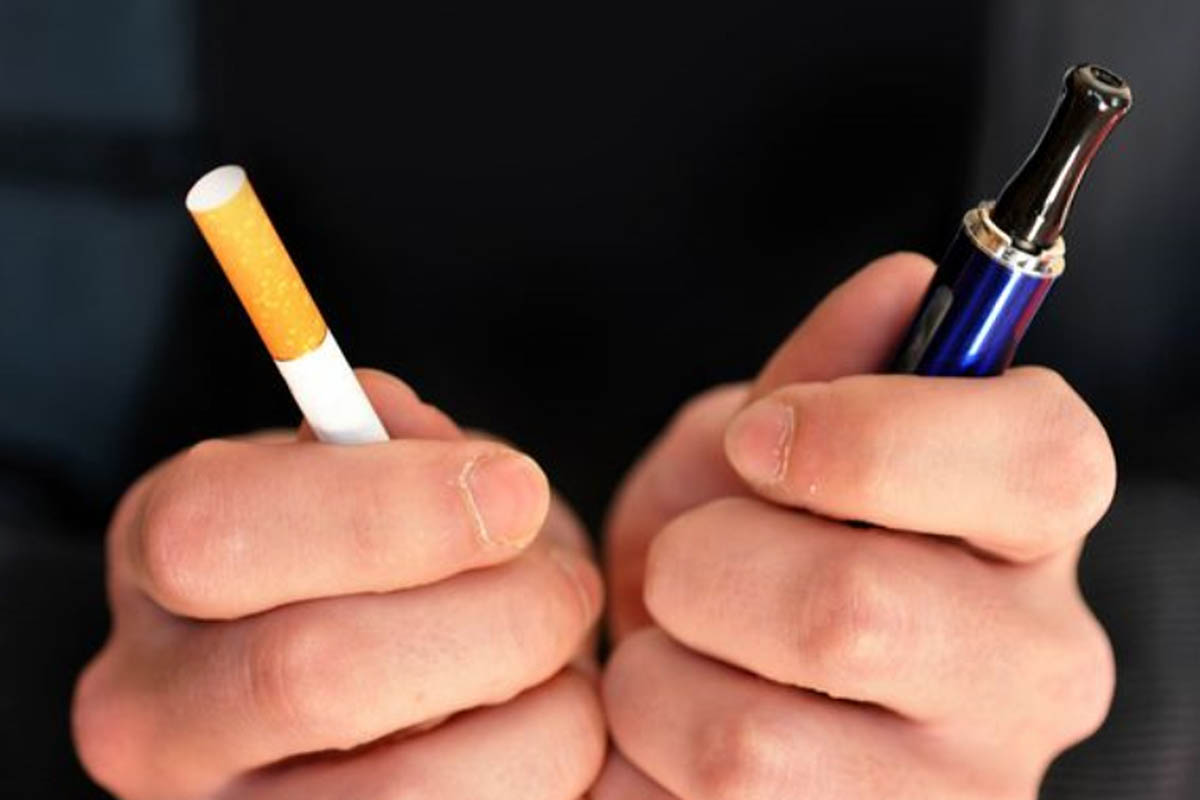
Both harm the environment in different ways. Cigarettes generate massive litter and toxic agricultural impacts, while vaping creates e-waste and battery disposal challenges, particularly disposable vapes, which combine the worst aspects of plastics, lithium batteries, and chemical residue in a single non-recyclable unit.
Rechargeable devices and batteries can sometimes be recycled through specialized e-waste programs, but most municipalities don’t accept them in curbside bins. Disposable vapes are nearly impossible to recycle because they mix batteries, plastics, and residual e-liquid that contaminate recycling streams.
They break down into microplastics while leaching nicotine, heavy metals, and other toxins into marine ecosystems. Fish, seabirds, and other wildlife frequently ingest them, mistaking the fibers for food, leading to digestive blockages and chemical exposure.
Choose refillable vaping systems over disposables, dispose of batteries and devices through proper e-waste channels rather than regular trash, never litter cigarette butts or vape components, and support brands offering take-back or recycling programs for their products.
The most actionable step remains proper disposal. Cigarette butts belong in trash receptacles, not sidewalks or beaches, yet they remain the most littered item worldwide. For vapers, seeking out the handful of manufacturers running take-back schemes can keep devices out of landfills, though these programs remain rare and inconvenient in 2026.
Regulatory approaches vary widely. Some jurisdictions have introduced extended producer responsibility schemes requiring manufacturers to fund recycling infrastructure or accept returned products. Others focus on banning single-use vapes entirely or mandating recyclable components. The UK implemented a disposable vape recycling scheme in 2024, while several US states classify vape batteries as hazardous waste requiring special handling.
On the tobacco side, proposals for biodegradable cigarette filters surface periodically but face technical hurdles, materials that break down quickly enough to reduce litter often compromise filtration performance or introduce new environmental concerns. No widely-adopted solution has emerged.
Individual choices matter, but systemic change requires manufacturer accountability and accessible recycling infrastructure. Until then, the environmental burden of both smoking and vaping falls disproportionately on ecosystems ill-equipped to process synthetic materials and industrial chemicals.
Both smoking and vaping present serious environmental challenges that extend far beyond their health implications. While vaping emerged partly as a harm-reduction tool for smokers, neither practice can claim environmental innocence. Traditional cigarettes continue to dominate global litter with trillions of toxic butts entering ecosystems annually, leaching heavy metals and microplastics into waterways for over a decade. Vaping, particularly disposable devices, creates a newer but rapidly escalating problem: lithium batteries, rare earth minerals, and plastic casings accumulating as difficult-to-recycle e-waste.
The lifecycle impacts run deep. Tobacco farming degrades soil and requires intensive pesticide use. Vaping device manufacturing depletes finite resources and generates carbon emissions. Both products release chemicals during use and leave persistent waste that harms wildlife and contaminates soil and water.
Individual choices matter. Opting for refillable vaping systems over disposables reduces waste significantly. Proper disposal through designated recycling programs prevents toxic materials from entering landfills and ecosystems. Supporting brands that prioritize sustainable packaging and take-back schemes amplifies positive impact.
Regulatory frameworks are evolving in 2026, with extended producer responsibility schemes and bans on certain disposable products gaining traction in various jurisdictions. Continued research into biodegradable materials, standardized recycling protocols, and lifecycle assessments will be essential for reducing the environmental burden. Until comprehensive solutions emerge, awareness and responsible behavior remain the most effective tools consumers have to minimize the ecological footprint of these products.