Related Posts

If you’ve picked up a battery labeled “not recommended for vape products” or similar language, the most likely reason is that it lacks the continuous discharge rating needed for vaping’s high-drain demands. These batteries may be designed for flashlights, power tools, or other devices with gentler power profiles, and using them in a mod can cause overheating, venting, or even thermal runaway.
The quickest diagnostic: check the battery’s continuous discharge current (CDR) rating. Purpose-built vape batteries typically feature CDRs printed directly on the cell or wrapper. If you see only capacity claims (such as “5000mAh” or “ultra high capacity”) without a specific amp rating from a reputable manufacturer, that’s a red flag. Many rewrapped or generic cells grossly overstate performance, and counterfeit batteries remain a persistent problem across online marketplaces in 2026.
This troubleshooting guide walks you through identifying unsafe cells, understanding why certain 18650s fail under vaping loads, and selecting replacements that meet both your device’s power requirements and current safety standards. We’ll also cover the connection between substandard batteries and common battery-related failures plus prevention strategies to avoid purchasing mismatched or dangerous cells in the first place.
Battery safety isn’t negotiable. If you notice any signs of damage (torn wraps, dents, excessive heat during use), stop using the cell immediately and dispose of it properly through a battery recycling program. Thermal events, while rare when proper cells are used correctly, can cause serious injury and property damage when ignored.
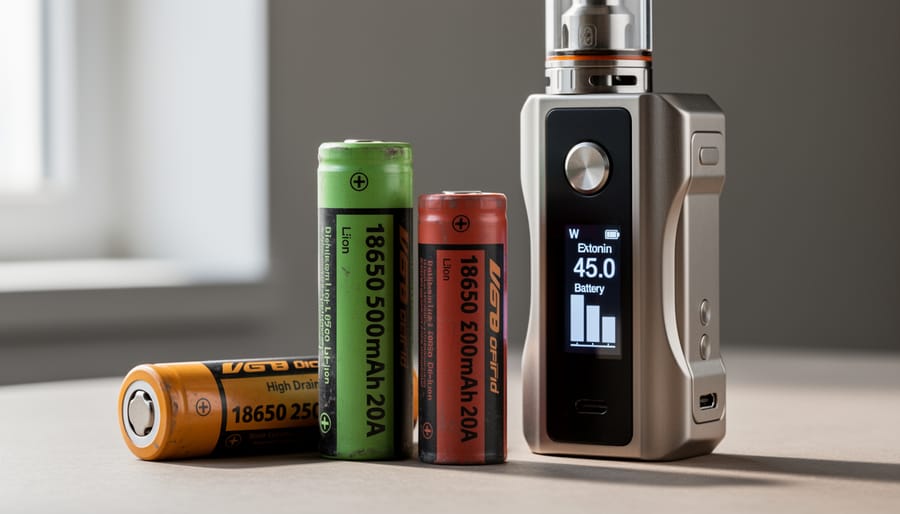
When you spot “not for vaping” or similar disclaimers on an 18650 battery label, that warning isn’t legal boilerplate, it’s a direct statement that the cell cannot safely handle the electrical demands your mod will place on it. The phrase signals a fundamental mismatch between what the battery was designed to deliver and what vaping requires.
Consumer electronics cells, the 18650s found in laptop battery packs, flashlights, power banks, and cordless tools, are engineered for low, steady discharge over extended periods. A laptop battery might deliver a few amps continuously to power a processor and screen for hours. A flashlight cell provides a fraction of an amp to illuminate an LED. These applications never stress the cell’s discharge capability, so manufacturers optimize for capacity (milliamp-hours) rather than power output.
Vaping devices operate on an entirely different principle. When you fire a mod, especially one with a sub-ohm coil, the battery must deliver a high-amperage burst to heat the coil rapidly. This demand can reach levels that consumer cells physically cannot sustain without overheating, venting, or entering thermal runaway. The current draw isn’t constant, it’s pulsed and intense, often for several seconds per inhale.
The distinction comes down to discharge ratings. Continuous discharge rating (CDR) measures how many amps a battery can deliver safely without overheating or degrading. High-drain vaping cells have verified CDRs that match real-world vaping loads. Consumer cells may claim high capacity but carry CDRs far below what vaping demands. When you exceed that limit, even in short bursts, you’re forcing the chemistry to operate outside its safe zone.
Pulse ratings complicate matters further. Some manufacturers list a pulse rating that sounds impressive but applies only to brief, infrequent bursts under ideal conditions. Vaping involves repeated pulses, often back-to-back, which generates cumulative heat the cell cannot dissipate. A battery rated for ten-second pulses with long recovery periods will fail under typical vaping patterns.
Generic 18650s salvaged from old laptop packs or purchased cheaply online lack the construction, chemistry, and testing that qualify a cell for vaping. They weren’t designed for this application, and no amount of device troubleshooting will change their fundamental limitations. The warning exists because the consequences of ignoring it are measurable and severe.
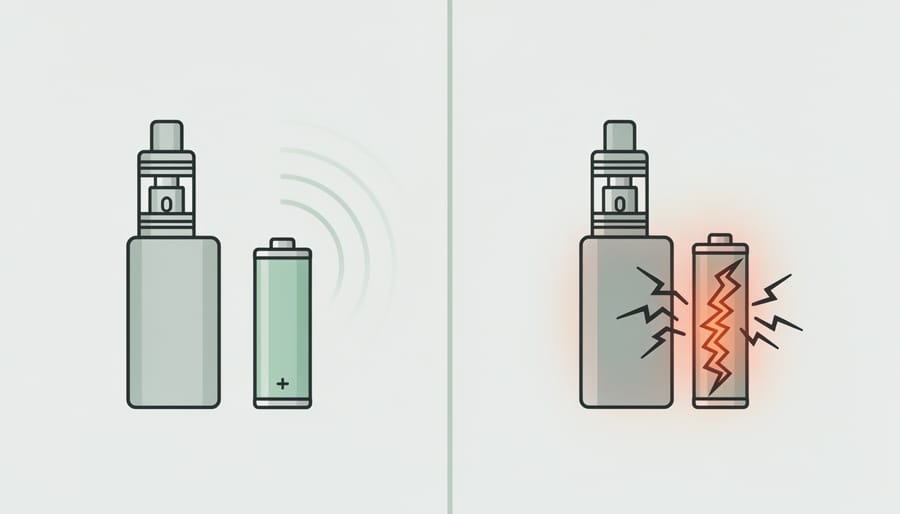
Vaping devices impose electrical demands that consumer electronics batteries were never designed to handle. When you press the fire button on a mod, the device requests a sustained current draw that can exceed what a typical laptop or flashlight cell safely delivers. The engineering that separates vaping-grade cells from household batteries comes down to chemistry, construction, and verified performance under stress.
The chemistry matters because not all lithium-ion formulations handle stress identically. Consumer cells often use cobalt-heavy cathodes optimized for energy density rather than discharge performance. These cells excel at powering laptops for hours but lack the current-handling capacity vaping requires. IMR and INR chemistries prioritize thermal stability and high-drain tolerance, accepting slightly lower energy density in exchange for safer operation when delivering substantial current.
Construction quality separates legitimate vaping cells from generic alternatives. Authentic high-drain batteries feature thicker current collectors, robust separator materials, and venting mechanisms engineered to release pressure safely if internal faults occur. The internal components must withstand repeated charge cycles at elevated temperatures without degrading rapidly. Consumer batteries lack these reinforcements because their intended applications never generate comparable heat or mechanical stress.
Third-party testing provides the validation buyers need. Reputable battery reviewers subject cells to discharge tests measuring actual performance against manufacturer claims. These tests reveal real CDR limits, voltage sag under load, and thermal behavior during sustained draws. Consumer batteries rarely undergo such scrutiny because their typical use cases don’t demand it. Vaping cells must prove they can deliver rated current without exceeding safe temperature thresholds, and independent testing confirms which models truly meet those standards.
Standard consumer cells fail in vaping applications because the current demand overwhelms their design parameters. What seems like an identical cylindrical battery becomes a thermal hazard when pushed beyond its engineered limits. The warning labels reflect this fundamental mismatch between device requirements and battery capabilities.

Understanding how inappropriate batteries enter the vaping ecosystem helps prevent dangerous mistakes. Most users don’t set out to buy unsafe cells, they end up with them through a handful of predictable pathways.
Purchasing unmarked or counterfeit cells online is the most common entry point. Third-party marketplaces and auction sites flood with batteries bearing no manufacturer markings, exaggerated specifications, or counterfeit branding. A cell wrapped in green plastic claiming 40A continuous discharge and sold in bulk packs often turns out to be a generic consumer cell with a 5A actual rating. The counterfeit wraps mimic legitimate brands closely enough to deceive buyers who haven’t learned to verify authenticity.
Salvaging batteries from other devices creates another frequent problem. Laptop battery packs, power tool batteries, and flashlight cells all use 18650 form factor, but they’re engineered for completely different discharge profiles. A cell designed to power a laptop steadily over hours cannot handle the high-current pulses that new vape device designs demand. Users harvesting cells from dismantled electronics rarely have datasheets or testing equipment to verify specifications, they assume size compatibility equals functional compatibility.
Confusion over battery specifications compounds the risk. CDR, pulse rating, capacity, and chemistry acronyms blur together for many users. A battery marked “3000mAh” sounds better than one marked “2500mAh,” even if the latter has twice the safe discharge capability. Capacity and current handling trade off against each other, but this relationship isn’t intuitive to someone selecting batteries for the first time.
Misleading rewraps exploit this confusion. Low-grade cells get wrapped in bright colors with impressive-sounding brand names and inflated numbers. The original cell underneath might be adequate for a TV remote but catastrophically inadequate for vaping.
Price-driven purchasing ties these issues together. Authentic high-drain vaping cells from known manufacturers cost more than generic consumer cells. When users see batteries at a fraction of the typical price, they often assume they’ve found a bargain rather than a warning sign. Quality batteries involve rigorous testing, premium materials, and manufacturing standards that cannot be undercut without sacrificing safety.
These red flags often appear together. A battery with two or more warning signs is almost certainly unsuitable for vaping, regardless of what the wrapper claims.
Navigating the marketplace for vaping batteries requires a methodical approach to avoid unsafe cells. The process starts with understanding what your device demands and ends with physical verification of what you’ve purchased.
Understanding how to read battery specifications separates marketing claims from genuine performance. Authentic datasheets from manufacturers like Samsung or Sony list continuous discharge ratings conservatively, often tested at elevated temperatures. When you encounter cells claiming discharge rates that seem extraordinary compared to known-good cells from major manufacturers, treat those claims with suspicion. A genuine datasheet includes test conditions, temperature curves, voltage cutoffs, and capacity measurements at various discharge rates, not just a single headline number.
For 21700 cells, the same verification principles apply, though these newer form factors often deliver higher capacity and current capability in a slightly larger package. The 21700 format has become popular in higher-powered devices because it offers more energy density, but this advantage only materializes if you’re using an authentic cell from a legitimate manufacturer.
The battery wrapper itself provides clues. Genuine cells feature crisp, clearly printed text with proper brand logos and model numbers. Counterfeits often exhibit blurry printing, misspellings, or suspiciously generic branding. Some counterfeiters rewrap low-grade cells in wrappers mimicking premium brands, so physical inspection must accompany vendor verification.
When in doubt about a specific cell model, consult independent testing databases maintained by battery safety advocates in the vaping community. These resources compile real-world test results that reveal a cell’s true performance characteristics, exposing exaggerated marketing claims before they endanger users.

Using the wrong battery in your vape creates a mismatch between what your device demands and what the cell can safely deliver. When a low-discharge consumer battery faces the high current draw of vaping, internal resistance heats the cell rapidly. The electrolyte breaks down, pressure builds inside the sealed casing, and the battery can vent, releasing hot gases, flames, and sometimes metal fragments. In severe cases, thermal runaway occurs: a self-sustaining chain reaction where heat accelerates further chemical breakdown, leading to fire or explosion.
The chemistry behind failure is straightforward. Vaping devices demand sustained high current. A consumer cell designed for steady, low-drain applications lacks the internal architecture to dissipate that heat safely. Electrodes degrade, separators fail, and short circuits can ignite flammable electrolyte. This explains why your 18650 is unsafe if it carries a warning label against vaping use.
Documented incidents show batteries venting in pockets, during charging, and while in use, causing burns, property damage, and loss of teeth or facial tissue in close-proximity failures. While comprehensive injury statistics are scattered across regulatory filings and case reports, what research shows confirms that nearly all serious battery incidents involve cells not rated for the applied load.
Device failure is another consequence. Excessive heat warps mod housings, damages circuitry, and destroys atomizers. Even if the battery doesn’t vent, chronic overheating shortens cell lifespan and degrades performance unpredictably.
The warning exists because the risk is real, immediate, and entirely preventable with the correct cell.
Preventing battery incidents starts with forming consistent safety habits before problems occur. Most vaping-related battery failures are avoidable through routine attention and informed practices, making prevention dramatically more effective than troubleshooting after a close call.
Store batteries in protective cases designed for individual cells, never loose in pockets or bags where metal objects can bridge the terminals and create a short circuit. Temperature matters: keep batteries away from heat sources and avoid leaving them in hot cars, where interior temperatures can degrade cell chemistry and increase venting risk. For daily carry, a simple plastic case costs little but eliminates the most common storage-related hazards.
Inspect your batteries weekly during active use. Look for any wrapper damage, dents, or scratches on the metal casing, even minor tears in the PVC wrap expose conductive surfaces that can short against your mod’s internal frame. Rewrap damaged cells immediately using heat-shrink battery wraps, or retire them if the damage extends to the metal can itself. Check the insulator ring on the positive terminal: if it’s missing, torn, or pushed aside, the entire top cap becomes a potential short hazard.
When using multi-battery devices, marry your cells from the moment you purchase them. This means charging, using, and retiring matched pairs or sets together, never mixing batteries with different cycle counts or brands. Married cells wear at the same rate, preventing imbalanced loads that stress one battery more than its partner. Mark married sets with matching labels or colored tape to avoid accidental separation.
| Safety practice | Why it matters | Frequency |
|---|---|---|
| Visual wrapper inspection | Tears expose conductive surfaces that can short against mod internals | Weekly during active use |
| Voltage check across married cells | Imbalanced cells stress one battery more than its partner | Every 10-15 charge cycles |
| Contact cleaning | Residue increases resistance, generating excess heat during discharge | Monthly or when performance drops |
| Capacity test | Declining capacity signals internal degradation and approaching retirement | Every 50-75 cycles |
Retire batteries when they no longer meet safe performance standards. Signs include noticeable capacity loss, getting unusually warm during normal use, taking longer to charge, or any physical swelling. High-drain vaping cells typically last 200-400 cycles depending on discharge rates and care, but treat these as guidelines rather than guarantees. When in doubt, replace rather than risk continued use.
Charge batteries in a dedicated lithium-ion charger with individual cell monitoring, not through USB passthrough charging in your mod unless the manufacturer explicitly designed the device for that purpose. Remove batteries from the charger once they reach full voltage, and never leave charging cells unattended for extended periods. These habits prevent the two most common charging-related risks: overcharging and thermal events during unsupervised charging sessions.
No. Laptop batteries are low-drain cells designed for steady, low-current discharge over hours. Vaping devices pull high, pulsed currents that exceed what these cells can safely deliver, creating venting and thermal runaway risks.
Nearly, but not exactly. Most genuine 18650 cells measure 18mm diameter by 65mm length, but protected cells with built-in circuits can be 1-2mm longer and may not fit tightly regulated mods. Rewrapped or counterfeit cells sometimes vary slightly in dimensions.
Check the manufacturer’s official datasheet, not the wrapper or retailer listing. Reputable testing sites publish independent CDR tests for common vaping cells. If a battery claims unusually high ratings or lacks verifiable documentation, assume the specification is exaggerated.
21700 cells are larger, 21mm diameter by 70mm length, offering higher capacity and often better continuous discharge performance in the same chemistry. They last longer between charges and can handle higher wattages more safely, but require mods designed to fit the larger size.
No. Protection circuits prevent overcharge, over-discharge, and short circuits, but they don’t increase the cell’s continuous discharge rating. A low-drain protected cell remains a low-drain cell, it will still overheat under vaping loads before the protection circuit can intervene meaningfully.
Rewrappers and unscrupulous sellers often print pulse or burst ratings instead of continuous discharge ratings, misleading buyers into thinking a cell can safely handle loads it cannot sustain. Always verify specifications against the original manufacturer’s datasheet and independent testing, not marketing claims on the wrapper.
These questions reflect the confusion many vapers face when navigating battery compatibility. The core issue isn’t just physical fit, it’s electrical capability. A cell might slot into your mod and fire initially, but if its chemistry and construction can’t handle the sustained high current your coil demands, you’re using a battery outside its safe operating envelope. Protection circuits and similar features address different failure modes, overcharge, deep discharge, hard shorts, but they can’t compensate for inadequate discharge capacity. Understanding these distinctions helps you move past superficial compatibility checks and focus on the specifications that actually determine safe performance under real vaping conditions.
The “not for vaping” warning isn’t arbitrary red tape, it’s a bright line between cells engineered for high-drain applications and those that will fail catastrophically under vaping loads. Every incident of battery venting, thermal runaway, or mod failure traces back to the same root cause: using the wrong chemistry or discharge rating for the job. Consumer electronics cells cannot handle the sustained current draw of sub-ohm vaping, and no amount of wishful thinking or price sensitivity changes that physical reality.
Not all 18650 or 21700 cells are interchangeable, despite identical form factors. The chemistry, construction, and tested continuous discharge rating determine whether a cell belongs in your mod or your recycling bin. Investing in verified, high-CDR cells from established manufacturers isn’t optional, it’s the baseline for safe operation. The cost difference is negligible compared to medical bills, device replacement, or worse.
Ongoing vigilance matters as much as the initial purchase. Inspect wraps, monitor performance, retire aging cells, and stay current on battery safety practices as mod technology evolves. The warning label exists because the consequences of ignoring it are real, immediate, and entirely preventable. Treat battery selection and maintenance as non-negotiable parts of vaping, not afterthoughts, and you eliminate the scenarios that put those warnings on consumer cells in the first place.